
One of the things we do regularly with our clients is help them structure their financial lives to take advantage of every legal tax deduction available.
One area that causes a lot of confusion is the business entity structure itself.
Questions like:
- When should I use one?
- Which entity is best?
- When should I not use one?
- How does my entity choice affect my taxes?
If you have any of these questions, take a look at our Entity Structure page for more information and get started with us to set up your business or help decide which structure is the best fit for your situation.
Legal Entity vs Tax Entity: What Is the Difference?
This is one of the most misunderstood parts of business structuring.
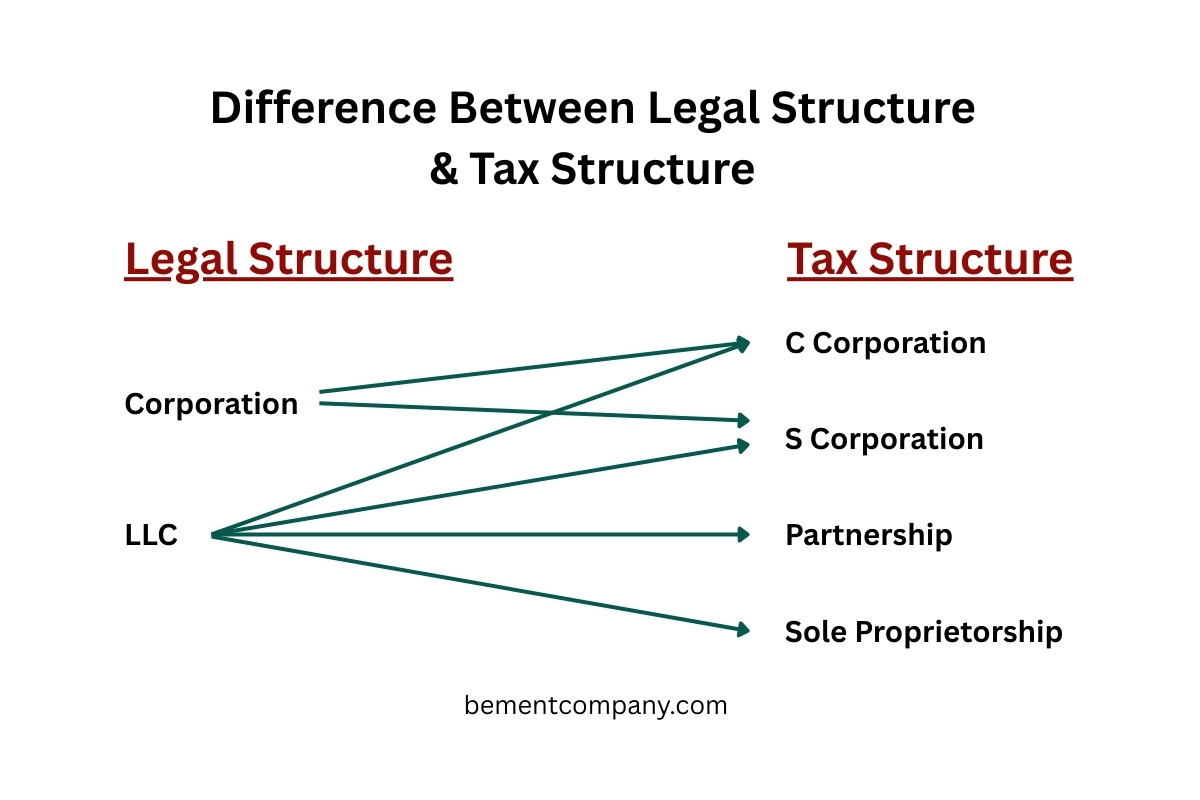
A legal entity is what you form with your state. Examples include LLCs and corporations. These exist for legal and liability purposes.
A tax entity is how the IRS treats your business for tax purposes.
Here is the key point: forming a legal entity does not automatically determine how you are taxed.
For example, an LLC can be taxed as:
- A sole proprietorship
- A partnership
- An S-Corporation
- A C-Corporation
So when someone says, “I have an LLC,” the real follow-up question is, “How is it taxed?”
Mixing up legal entities and tax entities can lead to missed savings or unnecessary taxes.
The Most Common Tax Entity Types
Sole Proprietorship or Disregarded Entity
This is the default tax status if you start earning income on your own or form a single-member LLC and make no additional IRS elections.
How it is taxed:
All income is reported on your personal return using Schedule C. You pay income tax and self-employment tax, which includes Social Security and Medicare at a combined rate of 15.3 percent.
When it makes sense:
- Side income
- Early-stage businesses
- Lower profit levels with minimal expenses
Partnership
If two or more people own a business and do not elect another tax status, the IRS treats it as a partnership.
How it is taxed:
The partnership files a separate return, but the business does not pay taxes itself. Profits pass through to the owners, who report the income on their personal returns and pay income tax and self-employment tax.
When it makes sense:
- Businesses with multiple owners
- Situations where simplicity is preferred over advanced tax planning
C-Corporation
C-Corporations are common among larger companies, but smaller businesses can use them as well.
How it is taxed:
The corporation pays a flat federal tax rate of 21 percent on profits. If profits are distributed as dividends, owners pay tax again at the personal level. This is known as double taxation.
When it makes sense:
- Businesses reinvesting most profits
- Companies seeking outside investors
- Certain benefit and retirement plan strategies
S-Corporation
This is where tax strategy becomes powerful for high earners.
How it is taxed:
The S-Corporation itself does not pay federal income tax. Profits pass through to the owner. The key advantage is that only wages paid to the owner are subject to payroll taxes. Remaining profits are not subject to self-employment tax.
When it makes sense:
- Businesses earning more than a reasonable owner salary
- High-income contractors or professionals
- Owners looking to reduce self-employment tax legally
Real-World Example on Why Entity Choice Matters
Let’s look at a simplified example.
Jordan is a high-performing sales professional earning $350,000 per year. Jordan switches from a W-2 role to a 1099 contractor position with the same income.
If Jordan does nothing and deposits the income personally, the IRS treats the income as sole proprietor income. That means the full $350,000 is subject to income tax and self-employment tax.
Self-employment tax alone would exceed $53,000.
Instead, Jordan works with us to set up an LLC and elect S-Corporation tax treatment.
Here is the result:
- Jordan pays a reasonable salary of $140,000
- The remaining $210,000 is taken as distributions
- Income tax still applies to the full amount
- Self-employment tax applies only to the salary
This structure saves roughly $32,000 per year in taxes.
Structure is a Strategy
Business entities are not just paperwork. They are strategic tools.
- The right structure can:
- Reduce taxes
- Improve credibility
- Create flexibility for growth
- Protect personal assets
If you are earning $300,000 or more, entity structure can be the difference between overpaying the IRS and keeping more of what you earn.
Here are a few podcast episodes we’ve created that go into more depth for entity structuring and the benefits:
- What Type of Entity do I Need
- Bement Blueprint – The 3 key entity structures for everyone
- Entity Structure – Tax Strategy Framework
- S-Corporation Benefits and Should you Convert your LLC
Final Thoughts
Choosing the right business entity is not about doing what everyone else does. It is about aligning your income, goals, and risk profile with the most efficient structure available.
When used correctly, business entities become one of the most powerful tax strategies available to high earners and business owners.
If you want to know whether your current structure is working for you or against you, our strategy team can help you evaluate your options.